


What Is 6.78MHz RF Technology in a 22D HIFU Machine?
A professional guide to radiofrequency tissue heating, focused ultrasound and the 18D RS handle of the Emmalaser 22D HIFU Max.
RF TECHNOLOGY / HIFU VS RF / CLINIC BUYING GUIDE
The Short Answer
6.78MHz RF refers to alternating radiofrequency electrical energy operating at approximately 6.78 million cycles per second. In aesthetic devices, RF can generate tissue heating through the interaction of current and tissue impedance. The Emmalaser 22D HIFU Max lists this feature for its 18D RS body handle. RF and high-intensity focused ultrasound (HIFU) have distinct energy-delivery mechanisms.
01What Does 6.78MHz Mean?
MHz stands for megahertz, or one million cycles per second. An RF generator operating at 6.78MHz produces an alternating electrical signal with a carrier frequency of approximately 6,780,000 cycles per second. This is an electrical specification, not a measurement of ultrasound treatment depth, RF power output or treatment temperature.
Different RF machines can operate at the same frequency yet produce different heating patterns because of their electrode geometry, output levels, contact conditions, cooling and tissue characteristics. The frequency alone does not establish penetration depth, effectiveness or safety.
02How Does 6.78MHz RF Heat Tissue?
In professional RF equipment, alternating electrical energy passes through an applicator and interacts with biological tissue. Electrical current and tissue impedance contribute to the conversion of energy into heat. Under controlled conditions, thermal exposure may produce collagen-related responses and remodeling; excessive or uneven heating can cause injury.
- Signal generation: the device produces high-frequency alternating electrical energy.
- Energy delivery: electrodes establish electrical current pathways within tissue.
- Thermal response: heating depends on the electrical field, tissue properties, power and treatment duration.
Radiofrequency
RF produces electrode-dependent heating through electrical-tissue interaction. Its carrier frequency is not a direct measure of heating depth.
Focused Ultrasound
HIFU concentrates acoustic energy into intended focal regions influenced by transducer design and selected cartridges.
036.78MHz RF vs HIFU: Key Differences
Radiofrequency and HIFU are both used in non-invasive aesthetic technologies, but they deliver energy differently. Evaluating their physical mechanisms helps clinics avoid oversimplified comparisons.
| Technical Aspect | 6.78MHz RF | HIFU |
|---|---|---|
| Energy type | Alternating electrical radiofrequency | Focused acoustic ultrasound |
| Heating mechanism | Current interacting with tissue impedance | Absorption of focused acoustic energy |
| Energy distribution | Dependent on electrodes, tissue and settings | Concentrated at intended acoustic focal zones |
| Typical aesthetic objective | Controlled tissue heating and firming | Focused tissue-tightening protocols |
| Meaning of MHz | Electrical oscillation rate | Acoustic oscillation rate |
A platform offering both RF and HIFU may provide different operating options, but it does not automatically prove better outcomes than either technology alone. Comparative performance claims require relevant evidence for the specific equipment and treatment protocol.
04Where Is 6.78MHz RF Used in the Emmalaser 22D HIFU Max?
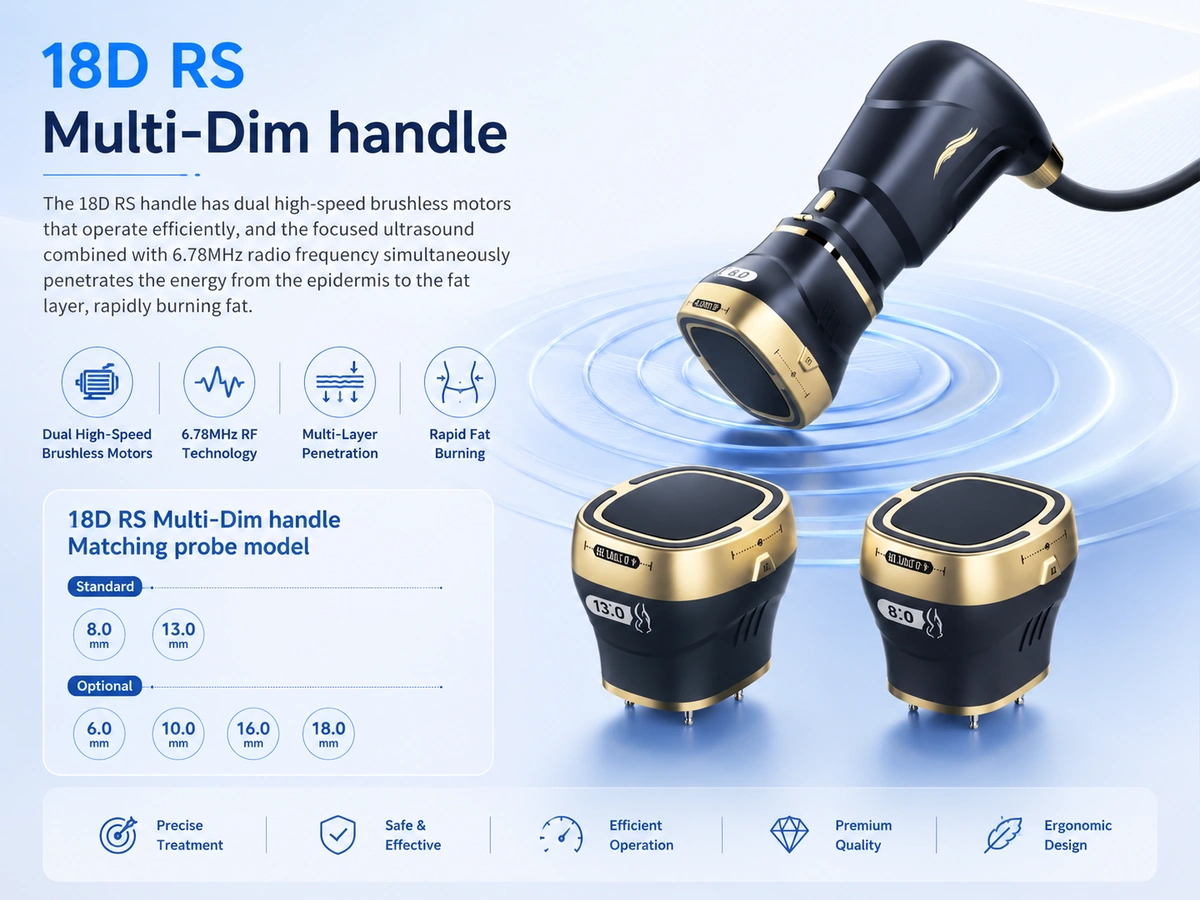
The manufacturer's product information identifies a 13D Multi-Dim facial handle and an 18D RS Multi-Dim body handle. The 6.78MHz RF-assisted output is specified for the 18D RS body handle.
22D HIFU Max Machine
The integrated platform is marketed for face and body applications. The device features a 13.3-inch HD smart screen with separate configurations for facial and body-oriented use.
See the official 22D HIFU Max product specification for configuration and purchasing information.
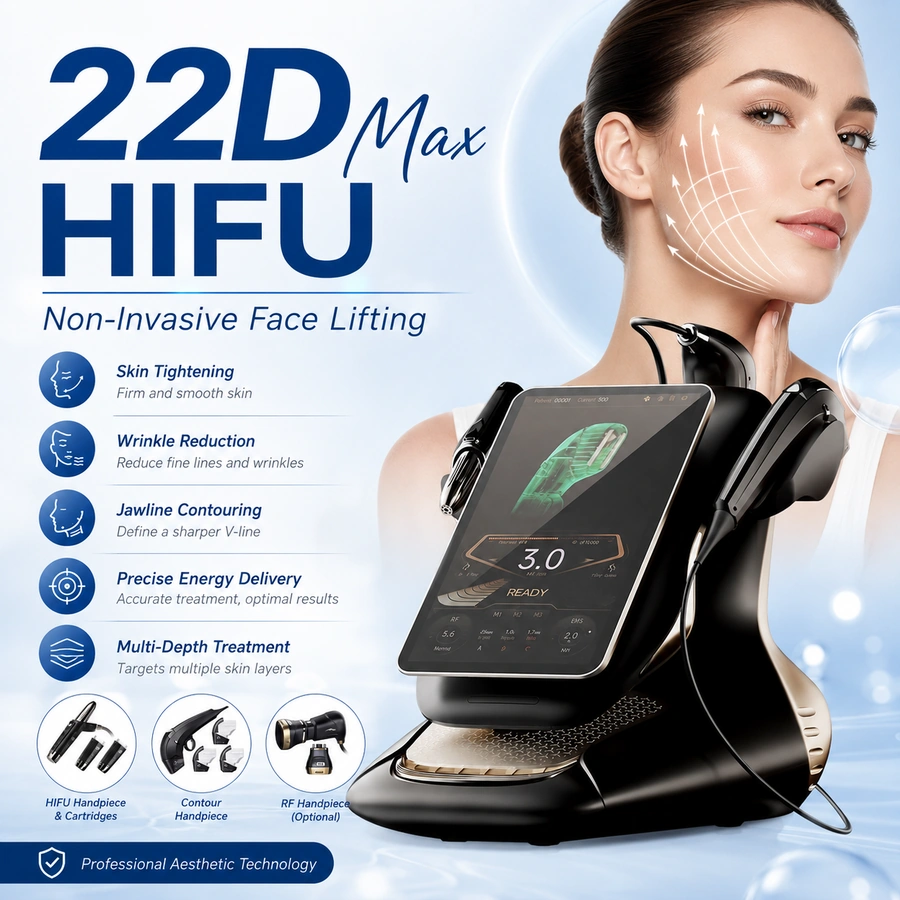
| Component | Published Specification |
|---|---|
| 13D facial handle | Standard depths: 1.5 / 3.0 / 4.5mm |
| 18D RS body handle | Standard depths: 8.0 / 13.0mm |
| RF function | 6.78MHz RF associated with 18D RS |
| 18D RS operation | Point, MP, circular and spiral modes |
| Display | 13.3-inch HD smart screen |
05What Does Scientific Research Support?
Peer-reviewed publications explain the thermal effects of radiofrequency energy and describe collagen-related responses. Research also addresses the use of focused ultrasound for selected aesthetic applications. These studies help explain the mechanisms involved but must be evaluated in the context of the specific device.
A published investigation of a different dual-frequency 6.78MHz/2MHz monopolar RF platform reported histological findings associated with tissue remodeling. This does not amount to clinical validation of the Emmalaser 22D HIFU Max.
What 6.78MHz Alone Cannot Tell You
- Actual RF output power or measured tissue temperature.
- Whether RF and HIFU are delivered simultaneously or sequentially.
- Exact heating distribution or guaranteed tissue penetration depth.
- Specific improvement percentages or long-term treatment outcomes.
- Whether a particular person is an appropriate treatment candidate.
06Professional Buyer's Checklist
Before purchasing an RF-assisted HIFU platform, clinics should obtain complete technical information and evaluate practical ownership requirements—not merely compare advertised frequencies.
RF Hardware and Controls
Verify the RF applicator, electrode configuration, operating modes, available output settings and safety controls.
Cartridges and Consumables
Confirm included depths, compatible replacements, service life, consumable prices and availability.
Documentation and Training
Request the instructions for use, intended applications, contraindications, applicable conformity documentation and training information.
Warranty and After-Sales
Review the warranty, troubleshooting process, replacement parts, technical support and maintenance needs.
Responsible Professional Operation
Energy-based aesthetic treatments require trained operators, appropriate patient screening and adherence to current instructions for use. Implanted electronic devices, certain implants near a treatment area, active skin conditions and other listed contraindications may influence suitability. Incorrect application can result in thermal injury. Local regulations determine who may operate a particular system.
07Frequently Asked Questions
Is 6.78MHz RF the same as HIFU?
No. RF uses alternating electrical energy and tissue impedance, whereas HIFU concentrates acoustic energy.
Which handle provides 6.78MHz RF on the 22D HIFU Max?
Emmalaser lists the 6.78MHz RF-assisted function for the 18D RS body handle.
Does 6.78MHz guarantee better or deeper treatment results?
No. RF frequency alone does not determine heating depth, clinical effectiveness or safety.
Can RF and HIFU operate together?
Some platforms incorporate both functions. Permitted simultaneous or sequential operation must be confirmed in the manufacturer's instructions.
Do studies of other 6.78MHz RF devices validate this machine?
No. General research can explain RF mechanisms but does not replace device-specific evidence.
What should clinics ask before purchasing?
Request the exact device configuration, RF specifications, instructions for use, regulatory documentation, operator training and after-sales terms.
08. Scientific References and Product Documentation
- The Landscape of Radiofrequency Technology for Skin Rejuvenation — review of RF technology.
- Efficacy of Dual-Frequency Noninvasive Monopolar RF in Skin Tightening: Histological Evidence — investigation of a different RF system.
- Emmalaser 22D HIFU Max — manufacturer product specifications.
Professional educational content only. This article is not a treatment protocol or device-specific clinical validation. Follow applicable instructions and local regulations.

