


Professional hair removal · Technology comparison
Diode vs Alexandrite vs Nd:YAG: Which Hair Removal Laser Should Your Clinic Choose?
A practical, evidence-informed guide to comparing wavelengths, patient suitability, cooling and long-term equipment support.

Diode, alexandrite and Nd:YAG: the main differences
A laser’s name identifies its source technology; the wavelength describes the light it emits. Those two facts are related, but they do not describe the entire treatment system. Pulse delivery, spot size, cooling and the instructions for the exact model also matter.
| Comparison point | Diode Commonly 808–810 nm | Alexandrite 755 nm | Nd:YAG 1064 nm · long-pulsed |
|---|---|---|---|
| Laser source | Semiconductor diode. Some systems combine several diode wavelengths. | Alexandrite crystal laser. | Neodymium-doped yttrium aluminium garnet crystal laser. |
| Patient matching | Evaluate the labelled skin types, cooling and evidence for the exact configuration. | Often considered for lighter, untanned skin with dark hair. | Often prioritised for darker phototypes when used with appropriate protocols. |
| Main consideration | A diode label alone does not establish suitability for every skin type. | Epidermal pigment and recent tanning require particular attention. | Lower melanin absorption at 1064 nm changes the treatment balance; patient selection still matters. |
| Cooling assessment | Confirm contact cooling performance and the recommended technique. | Check the supplied cooling method and its operating requirements. | Check cooling integration and validated long-pulse delivery. |
| Workflow assessment | Confirm handpiece ergonomics, actual spot sizes and sustained output. | Assess coverage, accessories and scheduled servicing. | Assess patient comfort, supported protocols and operator training. |
| Evidence to request | Studies relevant to the model, treatment mode, skin types and hair characteristics you plan to treat; documented maintenance and service terms. | ||
Patient-matching principles are drawn from clinical literature. [1] [2] Purchasing questions are Emmalaser’s editorial guidance. This table is an overview; treatment eligibility follows patient assessment and the specific device’s instructions.
Why wavelength matters—and why it is only part of the decision
Laser hair reduction uses selective photothermolysis: pigment in the hair absorbs light, which becomes heat. The aim is to affect the follicular target while limiting injury to surrounding skin. Epidermal melanin can also absorb energy, making skin pigmentation relevant to treatment selection. [1] [2]
A dedicated hair reduction platform
Diode systems use semiconductor emitters. For procurement, examine the complete configuration: wavelength mix, pulse controls, delivered energy and cooling. A broad product category cannot tell you how a particular handpiece performs.
Ask for evidence relevant to your patient mix and a demonstration of the specified operating mode.
Consider the skin–hair contrast
755 nm alexandrite is commonly considered where lighter skin and pigmented hair provide favourable contrast. The same interaction with pigment makes skin assessment and tanning history important. [1]
Review the model’s treatment indications and cooling arrangements rather than choosing on wavelength alone.
An important option for darker skin
Long-pulsed 1064 nm Nd:YAG has clinical evidence in darker phototypes, including skin types IV and V. [5] Lower absorption by melanin can support its use in more pigmented skin; it does not make treatment risk-free.
Confirm that the device is a long-pulsed hair reduction system and that your team has training for its intended use.
What do published studies actually tell us?
Study results should be interpreted alongside the patients, treatment area, protocol and follow-up period. A result from one system or one anatomical site should not become a performance promise for another machine.
Long-term evidence needs context
A review of long-term hair reduction included five eligible randomised trials with 223 patients. It did not demonstrate an overall superior laser or light device and highlighted the importance of body-site hair growth cycles when evaluating longer-term outcomes. [3] For a buyer, the practical question is whether the evidence resembles the service the clinic intends to offer.
More technologies did not automatically improve the result
A trial enrolled 20 participants with skin types III–IV and compared alexandrite, Nd:YAG and combined treatment on leg hair, with 18-month follow-up. Hair reduction differences between the treatment groups were not statistically significant. [4] This was a small study of specific crystal-laser protocols; it does not validate a multi-wavelength diode or establish equivalence between all devices.
Nd:YAG evidence in skin types IV–V
A prospective study of 200 patients evaluated a long-pulsed Nd:YAG system with sapphire cooling in skin types IV and V and reported favourable hair reduction and tolerability. [5] Its findings support consideration of that technology in darker skin, while its specific device and patient population limit how widely the results can be generalised.
These studies concern the systems and protocols evaluated by their authors. They are not clinical trials of EPYLASE. Emmalaser’s procurement recommendations below are an editorial application of the evidence.
Match the shortlist to your clinic’s patient population
Begin with a simple service profile: the skin types commonly seen, hair characteristics, treatment areas and expected workload. Use this profile when asking suppliers for documentation and when discussing equipment with the clinician responsible for treatment protocols.
Mainly lighter, untanned skin with dark hair
Include alexandrite and suitable diode systems in the comparison. Review clinical fit first, then compare coverage, cooling, support and ownership costs. There is little value in a technically impressive platform that does not suit the clinic’s actual services.
A substantial darker-skin patient population
Give long-pulsed Nd:YAG a prominent place on the shortlist. Evaluate any diode alternative against its specific instructions and evidence for these patients. A general “all skin types” statement should be supported by model-specific documentation.
A broad mix of patients and treatment areas
Compare a suitably documented diode platform with systems offering separate alexandrite and Nd:YAG sources. Ask how the available wavelengths are selected or blended and whether the clinical team can use them appropriately across its planned service range.
A new clinic developing its first hair reduction service
Prioritise clear training, accessible technical support and a defined service plan. Use realistic assumptions about appointments and downtime. The purchase decision should account for staff readiness and continuity of service as well as the machine itself.
These scenarios are purchasing examples, not individual treatment decisions. Patient assessment should include skin and hair characteristics, medical history, medications and recent tanning. [7]
Eight checks that make equipment quotations easier to compare
Send the same questions to every supplier. A written response tied to the exact machine and handpiece configuration makes the comparison reviewable.
- Identify the source and configuration Request the exact model, laser source, wavelengths and delivery method. Confirm whether the quoted system differs from the photographs or demonstration unit.
- Clarify what the power rating describes Ask whether a wattage refers to electrical input, an emitter rating or optical output. Request the available fluence and pulse specifications for each treatment mode.
- Review cooling under normal workloads Discuss the recommended contact technique, cooling checks and any operating limits. Ask for a demonstration that resembles the clinic’s planned workflow.
- Confirm actual spot sizes and ergonomics Request the dimensions of every supplied tip, how they are changed and the maintenance they require. Assess handpiece weight, cable reach and access around the treatment bed.
- Match the evidence to the intended patients Ask for clinical data relevant to the configuration, skin types, hair characteristics and treatment areas. Check how outcomes were measured and how long follow-up lasted.
- Verify market-specific documentation Check the exact model and intended use against the applicable regulatory documents. For US clearance claims, consult the FDA’s 510(k) database and the corresponding record. [9]
- Define training and service responsibilities Obtain written training scope, warranty exclusions, spare-part availability and repair arrangements. Include the handpiece and cooling system in the discussion.
- Compare the full ownership plan Include delivery, installation, servicing, replacement parts, staffing and potential downtime. Set realistic utilisation assumptions before modelling a return on investment.
Cooling and training belong in the purchasing decision
Cooling is part of the treatment system, alongside patient selection and parameter choice. [1] Ask how the supplied cooling method is checked, maintained and used in the device’s approved workflow. A quoted cooling temperature alone does not show how the system behaves during a full appointment.
The American Academy of Dermatology highlights the importance of experienced operators: burns, pigment changes and scarring can occur with inappropriate treatment. Everyone in the treatment room requires protective eyewear during laser treatment. [6] Your training plan should cover patient assessment, device-specific eye protection, treatment records, aftercare and escalation of unexpected reactions.
A clinic should also explain that hair reduction usually requires a treatment course and that maintenance may be necessary. Results vary with the patient and treatment site. [6] Use the clinician’s assessment and the device instructions to plan care.
Where does EPYLASE fit in the comparison?
Clinics evaluating a diode system can review the EPYLASE diode laser hair removal machine. Emmalaser’s product page describes a 755/808/1064 nm configuration, sapphire contact cooling, interchangeable treatment tips and training support. [10]
Use that page as a starting point for a written configuration review. Request the current datasheet, intended-use documentation, applicable market authorisations and service terms for the exact unit under consideration.
EPYLASE / Professional diode platform
Review the device. Compare the complete configuration.
Explore the product information, then discuss your clinic’s patient profile, treatment areas and expected workload with Emmalaser.
Explore EPYLASE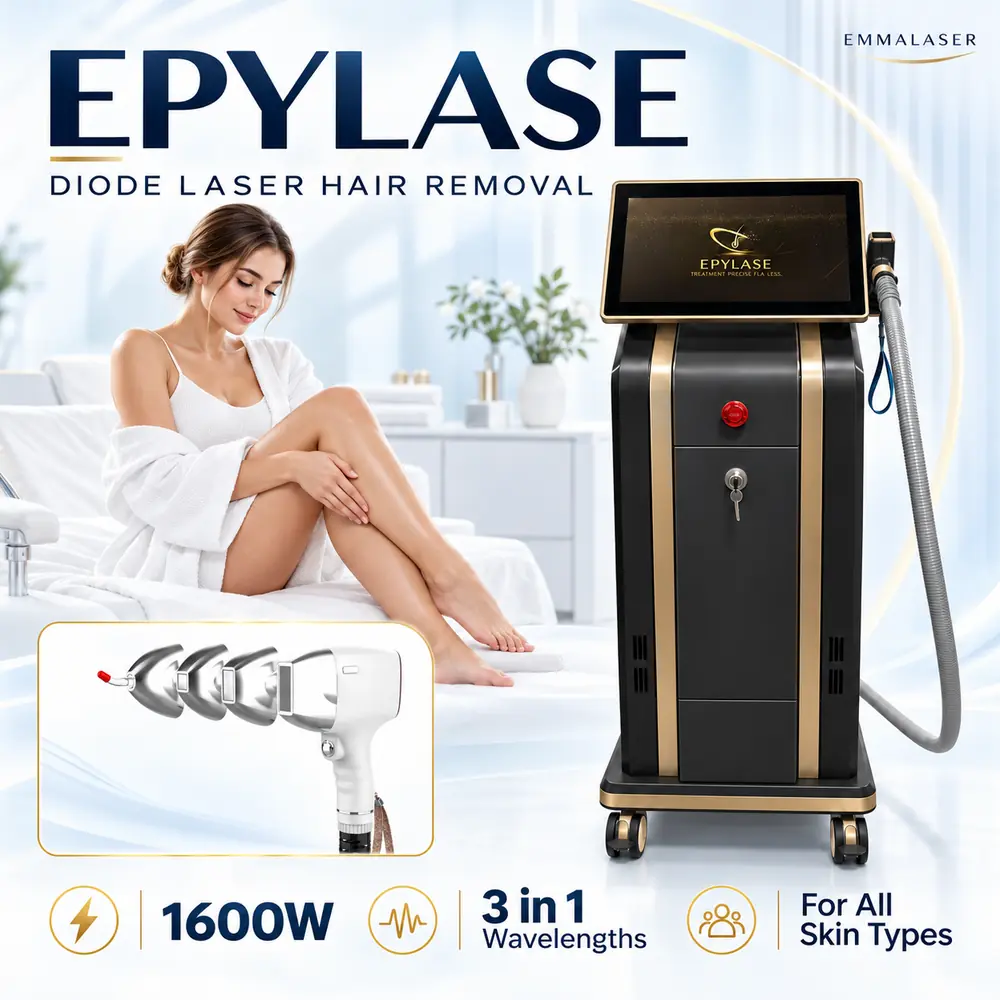
Frequently asked questions
Is a diode laser better than an alexandrite laser?
There is no universal answer. Compare the patient population, exact systems, operating modes, cooling and support. The long-term evidence reviewed here does not establish one technology as superior in every clinical setting. [3]
Why is long-pulsed Nd:YAG often considered for darker skin?
Longer wavelengths are an important consideration in treating more pigmented skin. Long-pulsed 1064 nm Nd:YAG has supporting clinical evidence in darker phototypes. [2] [5] Suitability still depends on the patient, the device and a professionally selected protocol.
Is a 755/808/1064 nm diode the same as alexandrite plus Nd:YAG?
No. A diode can combine those wavelengths while retaining a semiconductor source. A true alexandrite or Nd:YAG system uses a different laser medium. Wavelength labels alone do not establish equivalent pulse delivery, clinical results or patient suitability. [8]
Which laser is the least painful?
Comfort depends on the patient, site, treatment settings and cooling. In the small 2008 trial cited here, pain differed between the tested protocols. [4] A universal comfort ranking would overlook those conditions. Request a demonstration and review the device’s intended workflow.
How many sessions should a clinic promise?
Plan an individual treatment course rather than a fixed promise for every patient. Hair characteristics and treatment area affect outcomes, and maintenance may be needed. [6] Set expectations through consultation and follow-up.
What should I request before purchasing a professional laser?
Request the exact configuration and datasheet, intended-use documents, relevant regulatory records, training scope, warranty conditions and service plan. Ask the supplier to identify the evidence supporting the patients and treatment areas you intend to serve.
Clinical literature and verified resources
Clinical literature supports the technology discussion. Manufacturer materials identify product architecture and listed features; they do not independently establish comparative clinical superiority.
- Liew. Laser hair removal: guidelines for management. American Journal of Clinical Dermatology, 2002. Mechanism and patient-selection principles.
- Review of hair reduction in Fitzpatrick skin types IV–VI. Clinical literature review, 2017. Wavelength and protocol considerations in darker skin.
- Krasniqi et al. Systematic review of long-term hair reduction. Journal of Cosmetic and Laser Therapy, 2022. DOI: 10.1080/14764172.2022.2075899.
- Randomised alexandrite and Nd:YAG leg-hair study. Archives of Dermatology, 2008. Assessor-blinded comparison with 18-month follow-up.
- Prospective Nd:YAG study of 200 patients with skin types IV–V. Indian Journal of Dermatology, Venereology and Leprology, 2010.
- American Academy of Dermatology: laser hair removal FAQs. Patient expectations, operator experience, risks and protective eyewear.
- American Academy of Dermatology: preparation for laser hair removal. Consultation, medical history and tanning considerations.
- Alma: comparison of Soprano laser device architecture. Manufacturer explanation of combined-wavelength diode technology.
- US FDA: 510(k) premarket notification database. Official resource for checking model-specific clearance records.
- Emmalaser: EPYLASE product information. Manufacturer-listed configuration, cooling, accessories and support.
- Candela: Gentle Pro series technology overview. Manufacturer description of 755 nm alexandrite and 1064 nm Nd:YAG systems.

